


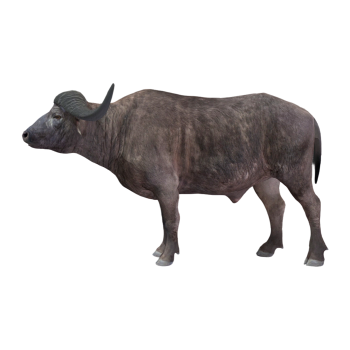
Buffalo (3D animated model)
Buffaloes are mammals of the genus Buffaloidae in the order Artiodactyla. Body size hypertrophy. Large head; Both male and female heads have a pair of horns, the horns are long and slightly flat, curved, the upper part has many nostrils, the forehead is wide, the mouth is large, the upper part of the upper lip has two large nostrils, the skin is hard and smooth, hairless; The nose is wide; The eyes and ears are very large; The neck is short; Waist-abdominal protuberance, limbs are short; The skin is thick, the anterior part of the body is dense, and the back and chest and abdomen are sparse. The body color is mostly gray-black, but also yellow-brown or white. It is named for its habit of being fond of water. Life can reach 20-30 years.
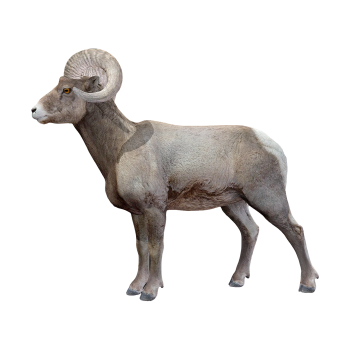
Canadian argali (3D animated model)
Canadian argali (scientific name: Ovis canadensis): Artiodactyla, boviidae, argali genus of mammals. There are 8 subspecies. Body length 1.5-1.8 meters, male weight 119-127kg, female weight 53-91kg. It is named for the crooked large horns of the ram. Although the ewe also has horns, it is much shorter and only slightly curved. The colors of the fur include light brown, gray and brown, while the hips and legs are white.

Spanish Goat
Goat (scientific name: Capra hircus) is a mammal of the genus Bovine Goat. Also known as summer sheep, black sheep. There are more than 150 goat breeds in the world, including dairy goat and hairy goat; there are more than 40 goat breeds in China, including Yimeng black goat and Cangshan black goat. The goat has a compact structure, a deep and broad chest, arched ribs, a straight back and waist, a large abdomen without drooping, regular limbs, strong bones, well-developed and elastic breasts, and large and neat nipples. Tip of mouth, sharp teeth, thin lips. Both male and female sheep have horns and beard. The coat is mostly white, accounting for more than 85%, the outer layer is coarse hair and the inner layer is fluff.

Twisted Horned Forest Antelope Specimen
The hornbeam antelope is a mammal of the genus Bokolinga in the order Artiodactyla. The fur is predominantly gray, with a white streak with distinct V-shaped white hairs on the nose and small white dots on both sides of the face. The ears are funnel-shaped, with long laryngeal spikes; only males have horns, the horns 1.7 meters long. The average life expectancy is 8-12 years. The horned antelope is distributed in eastern to southern Africa. It inhabits translucent forests or dense irrigation, often in mountainous or rocky areas. Active diurnal, 5-6 females form groups without rank, while 2-10 males form single groups. Vegetarian animals that feed on leaves, plants, tubers, flowers, and fruits.

Iranian Sheep Specimen
Ovine (Ovis aries) is a mammal of the genus Ovine in the family Boviidae, in the order Artiodactyla. The body is plump and covered with dense hair. Short head; Rams have large spiral horns, ewes have no horns or small horns; The skull has a tear socket and the nasal bone is relatively raised. Four hooves have toe glands; The tip of the mouth and lips are thin and flexible. Weight ranges from tens of kilograms to more than 100 kilograms, with a natural life span of about 15 years.

sheep specimen
Ovine (Ovis aries) is a mammal of the genus Ovine in the family Boviidae, in the order Artiodactyla. The body is plump and covered with dense hair. Short head; Rams have large spiral horns, ewes have no horns or small horns; The skull has a tear socket and the nasal bone is relatively raised. Four hooves have toe glands; The tip of the mouth and lips are thin and flexible. Weight ranges from tens of kilograms to more than 100 kilograms, with a natural life span of about 15 years.

Specimen of the Horned Antelope
The ornis belong to the bovidae. The neck of the horned antelope is relatively short, and the shoulder is slightly higher than the hip. The limbs are thicker and the feet are wide. The tail is round and thin, 25-35cm long, with long hair at the end. The hair in winter is long and rough, mainly grayish brown, and the hair in summer is sandy yellow. The forehead of the head has large black tufts of hair. Small eyes; The horns of both male and female are about 80cm long and female, and female, and female, which are relatively thin, curved posteriorly and then upward, respectively, and slightly resembled a flat spiral. There is also an easy to identify feature, in their forehead has a much darker than the body hair color, and the face hair is whiter than the body hair.

goat specimen
Goat (scientific name: Capra hircus) is a mammal of the genus Bovine Goat. Also known as summer sheep, black sheep. There are more than 150 goat breeds in the world, including dairy goat and hairy goat; there are more than 40 goat breeds in China, including Yimeng black goat and Cangshan black goat. The goat has a compact structure, a deep and broad chest, arched ribs, a straight back and waist, a large abdomen without drooping, regular limbs, strong bones, well-developed and elastic breasts, and large and neat nipples. Tip of mouth, sharp teeth, thin lips. Both male and female sheep have horns and beard. The coat is mostly white, accounting for more than 85%, the outer layer is coarse hair and the inner layer is fluff.

Grant gazelle skull specimen
The Gazella gazelle, also known as the great gazelle, is a species of gazelle that lives in East Africa and is known for its elegance and speed. Grant's gazelle has a beige to orange fur with a white belly. Shoulder height is about 75-95cm (30-37 inches). Males weigh between 50-80kg (110-180 lb) and females are slightly lighter, weighing about 35-50kg (77-110 lb). Both males and females have horns, but males have more prominent horns, measuring 45-81cm (18-32 in) in length, presenting a parabolic shape with a thicker base.

High-horned gazelle skull specimen
The high-horned antelope (scientific name: Aepyceros melampus) is a mammal of the cloven-hoofed bovine family high-horned antelope, also known as wide-angle antelope and impala. There are vertical black spots on both sides of the buttocks and black spots on the back heel. The female has no horns; the male's horns are long and harp-like, reaching 0.5-0.8 metres. The average life expectancy is 12 years. The high-horned antelope is distributed in Kenya, Uganda and South Africa in central and southern Africa. Likes to live in grasslands and open woodlands. Usually form a small group of 15-25 live together. In the dry season, small groups will gather together to form large groups of more than a few hundred.

Serval Antelope Skull Specimen
Serval Antelope (scientific name: Tragelaphus scriptus): body length 100-125cm, shoulder height 90cm, weight 45-80kg. Males are slightly larger. Mainly brownish red or yellowish brown. They have distinct vertical markings and the males have long spiral horns. There are 11 subspecies, with different patterns of fur and white streaks and spots on the face, depending on the subspecies with geographically different distribution.
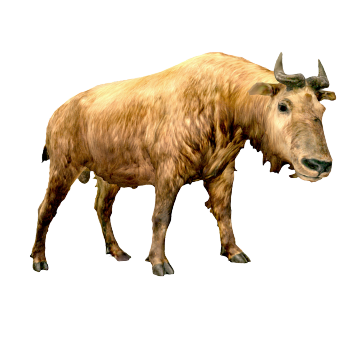
Takin specimen
Takins are also known as takins. This large ungulates are mainly distributed in the eastern the Himalayas, including Bhutan, China, India and Myanmar. It is a large ungulates belonging to the Bovidae family and Caprinae subfamily. They usually live in mountainous areas with an altitude of 2000 to 4500 meters and enjoy activities on the edges of forests and grasslands.

Blue antelope specimen
The Blue Antelope is a member of the Oxidae family, with a shoulder height of approximately 102-120 centimeters and a weight of around 180 kilograms. Its gray fur appears blue gray under strong sunlight. Distributed in South Africa, it became extinct in 1799 AD.

3D Animation Model of Saiga Antelope
It is a hoofed animal that lives on the Eurasian grasslands and belongs to the family Oxidae. Known for its unique, donkey like facial features and nose, which is particularly large and helps filter dust and regulate body temperature. Medium size, with dark brown fur in winter and light gray fur in summer. The horns are short and straight, with males having more prominent horns than females. Mainly inhabiting grasslands, semi deserts, and desert areas, feeding on herbaceous plants. It is a social animal that sometimes forms large groups of hundreds or even thousands of individuals. Migration routes and breeding habits have significant impacts on ecosystems. The quantity once sharply declined and was listed as an endangered species.

Western European bison skeleton
The Western bison is a member of the family Oxidae in the order Artiodactyla. The body length is 220-300 centimeters, the tail length is 40-60 centimeters, and the weight is 450-1000 kilograms. Both female and male animals have horns, which are slender and elongated. The horns first turn inward, then turn upward, and then bend forward. The tips of the horns then bend inward. Female animals have shorter and thinner horns. Small head, exposed snout, small eyes, and short ears. The neck is relatively short, with obvious hanging hair from the lower cheeks to the chest.

3D model of African wild buffalo with animation
Also known as African buffalo or African bison, it is a large herbivorous mammal found in sub Saharan Africa. Belonging to the cattle family, it is known for its communal lifestyle and fierce defensive abilities. Large in size, male individuals are usually larger than females, with broad chests, robust limbs, and large and long horns. The habitat is diverse, and it is a social animal. The strongest cow in the herd will become the leader of the group. It is nocturnal and avoids the scorching sun during the day, often hiding in cool places or mud to stay cool. Considered one of the most dangerous animals in Africa, especially cows that are injured, alone, or carrying calves, can be very aggressive.

Black Bull 3D Model with Animation
It is a common breed of livestock known for its strong physique and dark fur. Belonging to the bovine family, it is widely used in agricultural production and meat processing. They usually have well-developed muscles and wide breasts, which make them perform well in farming and traction work. The fur is usually completely black, and sometimes there may be variations of dark brown or gray. There are various shapes of corners, some varieties have long and curved corners, while others have short and straight corners. Eyes are usually large and bright, displaying their gentle nature. Plays an important role in agricultural society, not only for cultivation but also for providing products such as beef and cowhide.
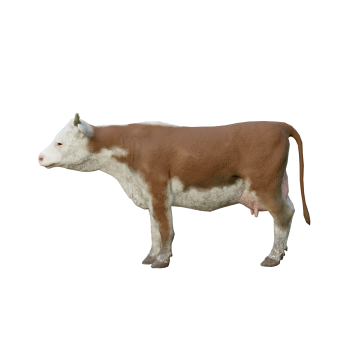
Cow (with 3D model animation) fbx
It is a large domestic animal belonging to the order Artiodactyla and family Oxidae in the mammalian class. Known for its milk production capacity, it is the main source of global dairy production. Breeding has a long history, as early as ancient Egypt in BC, humans began to domesticate and utilize dairy products from cows. Dairy products are not only nutritious and contain high-quality protein, calcium, and vitamins, but also have a wide range of uses and can be processed into various dairy products such as milk, cheese, butter, etc. The living habits are relatively mild, usually grazing on pastures or raising in captivity. It also holds a place in culture and is often seen as a symbol of diligence and abundance.

Blue horned horse (male) 3D model animation
It is an animal that lives in Africa and belongs to the bovine family. It is one of the common large herbivores on the African savannah, with a huge body size and a weight of up to 500 kilograms. Having a strong physique and sharp corners, the unique shape of the corners is spiral shaped. It is a social animal that usually migrates in groups in search of water sources and food. Every year, blue horned horses undergo a large-scale migration, a spectacular spectacle known as the 'Great Migration' and a great wonder in nature. Not only is it an important component of the African ecosystem, but it is also the subject of many wildlife photographers and nature enthusiasts.

Blue horned horse (cub) 3D model animation
It is an animal that lives in Africa and belongs to the bovine family. It is one of the common large herbivores on the African savannah, with a huge body size and a weight of up to 500 kilograms. Having a strong physique and sharp corners, the unique shape of the corners is spiral shaped. It is a social animal that usually migrates in groups in search of water sources and food. Every year, blue horned horses undergo a large-scale migration, a spectacular spectacle known as the 'Great Migration' and a great wonder in nature. Not only is it an important component of the African ecosystem, but it is also the subject of many wildlife photographers and nature enthusiasts.

Musk Bull Skull
Musk ox is a mammal of the genus Musk ox in the family Auchenipteridae of the order Artiodactyla. Musk oxen have a large body size, but are short and sturdy, with a large head, wide snout, and small eyes; Both males and females have horns, short and thick limbs, and wide hooves; Thick fur coat, extremely cold resistant, short tail. Male musk oxen emit a musk like odor during estrus, also known as musk oxen. Large polar animals living in northern Canada, Greenland, and Alaska, USA. Grass and shrub branches, and moss in winter. Relying on collective strength to cope with adverse weather conditions, musk oxen crowded together in groups, with young musk oxen placed in the middle and adult oxen facing away from the wind, keeping each other warm until the storm passed.

Indian bison skull
The Indian bison is a mammal belonging to the family Taurus in the order Artiodactyla. Large in size. Both males and females have thick and smooth horns, with a rough and flat base and pointed tips that curve diagonally backwards; Wide ears and nose, high shoulder peaks, and strong and powerful muscles throughout the body; Strong limbs; The body hair is relatively short. Whole body brown, white forehead; The area below the elbows and knees is white. Habitat in tropical and subtropical primitive evergreen broad-leaved forests, mixed coniferous and broad-leaved forests, or sparse tree grass slopes below an altitude of 2000 meters. Group living. During the day, activities are more frequent in the morning and evening, and there are certain areas and routes for activities and foraging. Has a habit of licking salt. Eat herbaceous plants as food, and also consume fresh and tender branches and leaves of some woody plants

Xizang Sheep Skull
Xizang sheep is an animal belonging to the sheep genus (Argali) of Bovidae, Sheep subfamily and Ovine subfamily. Grassland type Xizang sheep have strong physique. The head is rough and triangular in shape, with a raised nose bridge. Both male and female sheep have horns, with the horns of male sheep being thick and often extending in a spiral shape to both sides, while the horns of female sheep are flat and smaller, twisting and extending outward. Open chest, straight back and waist, well developed bones. Strong limbs and solid hooves. The body of Xizang sheep of Sanjiang type is rectangular. There are two types of ram horns, one is a large curve that bends backwards and forwards, and the other is twisted outwards. Most ewes have horns. The tail is conical, and the average length of a ram's tail is 12 centimeters. Most applications have black or brown patches on the head, neck, and tail.

Popular Models


Honey Badger (3D animated model)
192 View

Guinea fowl (3D animated model)
163 View

Wild Goose (3D animated model)
185 View

Red Fox (3D animated model)
153 View
Random Model

Emerald Silver Ring
748 View

Porsche 911 with interior design
1236 View


Old style military kettle
1227 View


Earth rotation animation
670 View


Peregrine Falcon Specimen
806 View

Adidas Gazelle sneaker
520 View
